 | Chinese
- Home
- Intro
About JiaheDevelopment History
- News
- Products
Shafted Helical FlightsShaftless Helical FlightsShafted Screw Assemblies

News
Technical Resources
Engineering Design Parameters and Industrial Application Scenarios of Screw Feeders
Date:2026-11-04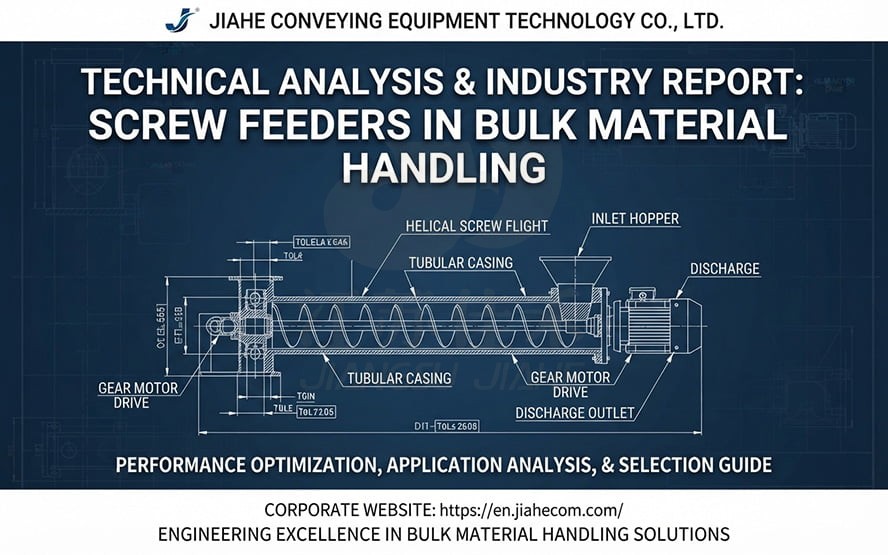
Engineering Design Parameters and Industrial Application Scenarios of Screw Feeders: A Comprehensive Technical and Industry Analysis White Paper
Abstract
In modern continuous automated processing lines, the reliable volumetric dosing and transport of bulk solids are critical to global industrial efficiency. The industrial screw feeder serves as a primary mechanical displacement vector utilizing an engineered helical flighting assembly inside an enclosed housing. Jiahe Conveying Equipment Technology Co., Ltd. presents an extensive technical analysis of mechanical principles, design parameter matrices, kinematic equations, operational behaviors across four macro-sectors, and non-standard technical selection methodologies.
1. Industrial Bulk Material Handling Background & Technical Definition
1.1 The Evolution of Systems
Managing diverse bulk solids requires mechanical conveying that maintains environmental isolation, prevents cross-contamination, and optimizes spatial layouts. While pneumatic and belt systems present limitations regarding energy use, particle attrition, or inclination angles, the industrial screw feeder offers high volumetric efficiency and total vapor-tight containment.
1.2 Fundamental Kinematic and Tribological Principles
Screw feeder operation mimics a mechanical nut-and-screw thread pairing where the rotating helical blade acts as a driving inclined plane. Material experiences axial thrust, radial centrifugal force, and frictional drag against the casing wall. Forward displacement requires that the collective mass and wall friction resist co-rotation, forcing the material to slide along the advancing blade face.
2. Core Structural Categories & Comparative Technical Utility
2.1 Shafted vs. Shaftless Screw Feeders
Shafted Configurations: Ideal for dry, free-flowing granular materials, offering high torsional stiffness and higher rotational speeds supported by intermediate bearings, though prone to jamming with cohesive or fibrous substances.
Shaftless Configurations: Designed for sticky, wet, or fibrous matter. The absence of a central shaft prevents wrapping and increases cross-sectional capacity, though constrained in single-stage conveying length and maximum inclination.
2.2 Tubular vs. U-Trough Housings
Tubular casings provide high pressure resistance and optimal steep-angle performance, whereas U-troughs offer superior maintenance accessibility and multi-point discharge flexibility.
3. Critical Performance Parameters & Engineering Calculations
Jiahe Conveying coordinates standardized design matrices and kinematic calculations to verify empirical performance. Theoretical volumetric throughput and required drive shaft power are derived using established formulas incorporating fill factors, inclination correction factors, bulk density, and resistance coefficients. For detailed mathematical expressions and parameter matrices, please refer to the referenced technical document.
4. Operational Behavior in Multi-Industry Scenarios
Municipal Wastewater: Utilizes shaftless flights and UPE wear-resistant liners to handle cohesive, high-moisture sewage sludge without wrapping or blockages.
Fine Chemicals: Employs seamless cold-rolled stainless steel with electropolished surfaces and positive-pressure purged seals to meter hygroscopic or toxic powders safely.
Agricultural Processing: Relies on oversized geometries at low rotational speeds and anti-bridging agitators to prevent kernel breakage and material bridging.
Heavy Metallurgy: Utilizes thick sectional manganese alloys, automated hardfaced weld overlays, and tungsten carbide thermal sprays to resist abrasive wear under extreme loads.
5. Non-Standard Engineering Specification & Custom Selection
Selecting an appropriate screw feeder requires profiling material properties—such as bulk density, angle of repose, particle size distribution, and chemical reactivity—followed by matching the layout, housing style, and surface treatments to the specific operational environment.
6. Technical Conclusion
Modern bulk handling relies on custom-configured screw feeders integrated with advanced surface engineering, predictive monitoring, and precise volumetric-to-gravimetric control. Jiahe Conveying Equipment Technology Co., Ltd. provides comprehensive testing and manufacturing solutions to optimize industrial efficiency.
Corporate Engineering & Global Service Directory
Global Technical Support Hotline: +86-400-990-1585
Official Corporate Web Portal: https://en.jiahecom.com/
Manufacturing Center Address: No. 3, Garment Road, Xuyi County, Huai'an City, Jiangsu Province, China
Technical Document Reference Code: JH-BHM-2026-V3
Copyright © 2016-2026 Jiahe Conveying Equipment Technology Co., Ltd. All Rights Reserved.The summarized technical report has been provided above based on the referenced documentation. Let me know if you need further adjustments or specific project calculations.
Next:No content - News